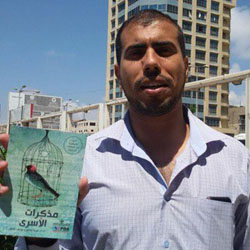
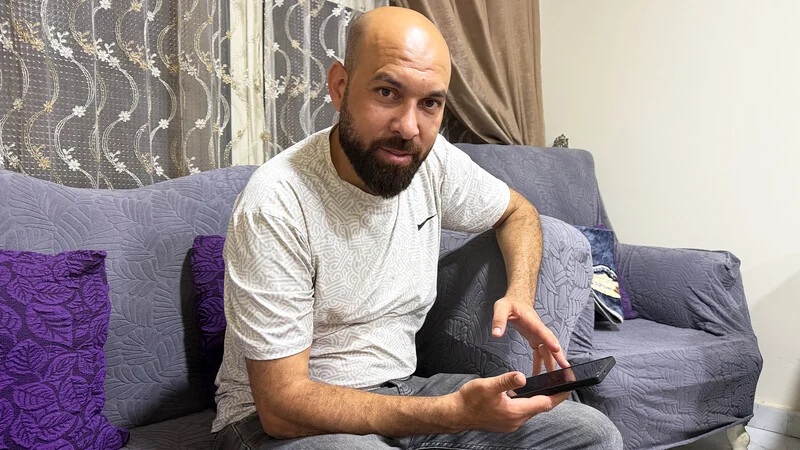
Ayham Kamamji in Cairo in September 2026. Ruwaida Amer
I meet Ayham Kamamji, one of Palestine’s most famous prisoners, in Cairo. He is at times effervescent, when recounting winning his freedom, and at other times despairing, when he talks of what he has lost. Now 40, he spent nearly 20 years in Israeli prisons – most of his adult life – and was released in October 2025 as part of the Gaza ceasefire agreement and then deported to Egypt.
Originally from the village of Kafr Dan, west of Jenin in the occupied West Bank, Kamamji was first arrested at the age of 16. He was later imprisoned and sentenced to two life sentences.
Over a period of two hours, Kamamji talks to The Electronic Intifada about his time in – and escapes from – prison, his part in the revenge attack for Huda Ghalia’s family in June 2006, how the Palestinian prisoner movement has been “destroyed,” and the fear that Mossad are still after him.
His political ideology
“Asking someone from Jenin refugee camp how they came to think this way is like asking a plant why it has roots. We were born into an environment, a community and an understanding of religion, and the sheikhs who always taught us about jihad, love of country and sacrifice.
“They taught us that Palestine is the most precious thing we possess, that Jenin is a part of our homeland, that our souls reside within it, and that our dignity and honor lie in jihad.
“We are talking about a generation that passes the torch to the next, becoming a friend to it. For example, if my uncle, friend or neighbor is a martyr, and I love him, I will follow in his footsteps. This is a generation that passes the torch to the next.”
Education in prison
“I completed my high school diploma outside of prison and tried to attend university, but I was in hiding from the Israeli special forces, so I then withdrew from university and did not complete my studies.
“While in prison, I was able to continue my education and earned a bachelor’s degree in history from Al-Aqsa University, a bachelor’s degree in social sciences from Al-Quds Open University and a master’s degree in business administration from Cairo University.”
First operation
At the age of 16, Kamamji attempted his first operation against the Israeli occupation, a failed car bombing inside Israel. He was arrested and imprisoned by Palestinian Authority forces, before his first prison escape.
“I was arrested in May 2003 after attempting a suicide bombing with a car bomb. The car malfunctioned, and I couldn’t detonate it, so I withdrew.
“I was imprisoned by the [PA’s] Palestinian Preventive Security service under the guise of ‘protection.’
In 2004, “I then escaped from Jericho prison with a group of young men. We fled to Jenin refugee camp, but we were pursued, and most of the young men with me were assassinated.
“I then escaped to Ramallah, where the revenge attack on Huda Ghalia’s family took place. I was subsequently arrested by the PA, and that same night, I was handed over to the Israeli army and arrested.”
Huda Ghalia revenge plot
In 2006, Huda Ghalia, an 11-year-old child, became known to the world after video emerged of her crying on the beach in Gaza, calling for her father.
He had just been killed in an Israeli shelling, alongside six other family members. His body was on the beach, and Huda held his dismembered leg while standing next to his body.
“The revenge operation carried out for the sake of Huda Ghalia’s family was conducted by me and a group of young men. The operation involved kidnapping a settler studying at the Mercaz HaRav’s military academy.
“The kidnapping of Gilad Shalit in Gaza coincided with our kidnapping of the settler Eliyahu Asheri. The time difference between the two operations was 12 hours; they kidnapped him at 7 am, and we kidnapped him at 7 pm. The two operations coincided by chance, without any coordination between us.

APA images
“That day was a double blow to Israel, with two operations occurring simultaneously in the West Bank and Gaza. They underestimated the West Bank operation.
“Our operation was exposed because of Israel’s threat to launch a war on Gaza. We announced that if a war were launched on Gaza, or even a single shot fired, we would kill the settler we had in our custody. From the beginning, they denied our account, and we were forced to release his photos and identity.
“The existence of two kidnappings created pressure on the Israeli public, which preoccupied them for hours, delaying a war on Gaza. This helped the young men in Gaza to move Gilad Shalit from Rafah [in southern Gaza] to an undisclosed location. We were discovered, and I shot the settler in the head, killing him.
“I carried out my threat because they started a war on Gaza and assassinated five members of the Qassam Brigades [the armed wing of Hamas] in Khan Younis.”
The body of Asheri, 18, was recovered in the Ramallah area of the West Bank several days after his abduction. His father Yitro Asheri – an Australian who converted to Judaism – was one of the founding settlers of Itamar, a colony notorious for violent attacks against Palestinians in the northern West Bank.
“After [the settler] was killed, Israel focused heavily on the West Bank and divided its forces between Gaza and the West Bank. Therefore, the PA helped Israel by imprisoning us. Then the Israeli army stormed the prison where we were being held and intended to execute us, but there were cameras that proved we were alive. We were then transferred to another prison.”
Prison conditions
“We went to prison, and the interrogation was very harsh. The physical torture was mild, but the psychological torture was much worse. For example, they would throw us into something called a refrigerator, [a toilet] less than a meter-by-a-meter in size, so small that a person would have to put their head in the toilet bowl.
“We’re talking about 2006: Prison conditions were better than they were in these last three years of the war. But we’re talking about the psychological impact of interrogation, like being given rotten eggs, hearing the screams of a madman, and the guards assaulting us for no reason.
“They would take us around with our faces covered and make us walk through a space with iron beams, banging our heads against them. The interrogation lasted 35 days, the worst I’ve ever experienced, 25 of which were continuous.
“At the beginning, they used continuous interrogation on me, where they would put me on a chair and tie me to it. This was so bad for my joints that if the guard untied me and asked me to stand, I couldn’t. They also put us under air conditioning at an abnormally high temperature.
“It was the golden age, the peak of the prisoners’ movement, which lasted until 7 October.”
“The feeling of escaping was beautiful”
In 2021, Kamamji escaped Gilboa prison in northern Israel alongside five other prisoners, in a breach that shook the Israeli security establishment. Planning the escape took nine months, as the prisoners worked tirelessly together to dig a tunnel through the prison wall. Kamamji was eventually caught after two weeks.
“The feeling of escaping was beautiful, but it doesn’t compare to the joy of the deal. In the first [instance], I escaped against their will but in secret, while in the second, I was freed against their will and right before their eyes.
“The downside [of the escape] was that I was afraid for those around me. I surrendered myself out of fear for the family I was hiding with and out of fear of a war being launched on Gaza. I have six brothers, one of whom is a martyr, and we have five left.”

APA images
Kamamji’s brother Shas was shot and killed by Israeli forces at the age of 29, near Jenin, during a wave of raids in the West Bank.
“I was afraid for my friend’s family where I was staying. I didn’t have absolute happiness, and my fear and anxiety stemmed from my fear of harming the people around me.
“I kept thinking about how many people would be killed if a missile was launched. I left the camp for the sake of the armed men who came to protect me. They gathered hundreds of armed men from Jenin who refused to hand me over.”
Return to prison
After he was captured again, Kamamji was held at Megiddo prison in northern Israel, which has become notorious for human rights abuses. In a January 2026 report, Israeli human rights group B’Tselem documented how Israeli prisons have been turned into “torture camps” under the watch of Kobi Yaakobi, an ally of far-right national security minister Itamar Ben-Gvir, and responsible for the prison service since early 2024.
Kamamji recalls a moment in 2025, when guards suddenly mounted an attack on the prisoners.
“I was sitting on my bed with nothing but a blanket and the clothes I was wearing. I was holding the Quran and reading from it. … It was Ramadan, and the way they stormed the prison was barbaric.
“They opened the door and attacked me with weapons. One put a gun to my chest, another to my stomach, and another to my back. They slammed me against the wall, and [Yaakobi] entered like a Colombian gangster, flexing his muscles. I felt they had abandoned all laws and humanity. A prisoner was executed in front of me, and another committed suicide in the cell opposite mine.
“Yaakobi was in charge of all the guards. He came to see me and said I was the first security prisoner [he was meeting]. He asked me, ‘Do you know me?’ I told him, ‘Yes, Kobi Yaakobi.’ When he became a commander, I was shocked because he’s a very extremist figure and close to Ben-Gvir. When he became commander, I was certain that Israel would mistreat the prisoners. He asked me what problems there were, and I told him. He retorted that I was speaking to him as just a prisoner, and that’s when I realized it was an attack from the higher administration [designed to humiliate me].”
The moment of true freedom
He recalls the moment in October 2025 when, unbeknownst to him, the prisoner release was underway as part of the Gaza ceasefire deal.
“For four years, I was in solitary confinement, one of the most nerve-wracking periods of my life. I was sitting in isolation when the Israeli forces stormed in. … [The guards] would break in and beat us. At any time, they would beat us and take us to the yard, leaving us in the cold.
“They were speaking to each other in Hebrew and called my name. I sensed something was wrong. They told me to turn my face away, and I was used to that, knowing I was going to be punched. They took me outside and dragged me about 100 meters, where I was beaten.
“I felt that I was going to be released from solitary confinement, and that was my biggest dream.
“Then a guard came and signaled at me and asked where I was from. I told him Megiddo prison because I had spent a long time there and didn’t think he was going to ask anything else.
“But he asked which city I was from, and I told him Jenin. I hadn’t heard about a deal, and the lawyer wasn’t allowed to speak with us.
“I shaved my head myself. Someone told me I was going to be executed, and I thought it was true because there were cameras. But then I heard someone say the deal would be finalized in two days, and I started wondering if it was an execution or a deal.
“I heard on the news that the war had ended and we were transferred to a prison in the Naqab. We weren’t beaten. There was an Israeli officer I knew there named Shalom. He told me, ‘Congratulations, don’t do anything outside.’ I asked him if the war was over, and he said it was and that I would be released at 3 am. Then it was postponed. I told him to keep me updated, and he said, ‘Don’t worry, I’ll say goodbye before you go.’ He was one of the humane officers.
“Then I met with the Shin Bet, and they told me I was going to Gaza. I spoke with my father to tell him, and we were released. It was a lie: The war on Gaza hadn’t ended.
“They told me I was going to Gaza, and then two days later, [it] was changed to Egypt. But I didn’t care where I was going because I just wanted freedom.”
“Calamities greater than prison”
“I was released from solitary confinement and taken to Egypt, from a place with no one around to a country of [over 120 million people]. When I arrived in Egypt, they put me in a hotel, and after a week and a half, I left and never went back. I found life.
“It was a great blessing to be free, but my sorrows began again when we entered Rafah. The destruction we saw was something we hadn’t expected; seeing it was harder than hearing about it.
“When we were received at the Egyptian side of the Rafah crossing and given clothes, I went to change out of my prison clothes, shedding with them 20 years of humiliation, oppression, deprivation, hunger and suffering. I felt like something had been lifted from my shoulders.
“For the first two or three months, I lived with the phobia of being arrested again, the fear that Mossad would arrest me once more. I moved around in fear, unable to comprehend the idea of prison: It was impossible for me to go back. For three months, something prevented me from being happy because of the constant thought of being arrested.
“I gradually began to reintegrate into life and discovered that there were calamities greater than prison: the alienation and separation from my family, the inability to see them and the hardship of life.”
Fate of prisoners
“We [the released prisoners] are currently far removed from political life and have begun to focus on our own lives. The challenges we face are particularly acute after the PA cut off our salaries. We haven’t received a salary since March 2025, when I was imprisoned. We emerged to a very harsh reality.
“I have a future ahead of me, but I can’t live it. I don’t have the money to build a house. I am psychologically, socially, economically and emotionally unstable. I am separated from my family in Jenin and my fiancée in Gaza. I haven’t seen any of them: They are banned from traveling.
“No one cares – not the PA, not the organizations, not the associations, not the institutions. How am I supposed to live? I sold a piece of land, and the money will run out. What will I do then?
“Egypt told us it is receiving us because no one else is willing to. Don’t expect residency, living allowances, housing or anything else. If any country wants to receive us, they are welcome. If a prisoner wants to leave Egypt at his own risk, he will never return.
“The passports for the last group of prisoners haven’t been stamped yet. I don’t have any personal identification: I have no personal documents.
“We approach the PA with many issues, but they don’t cooperate with us. They tell us they weren’t involved in our release from prison or the deal that was made. The prisoners’ salaries have also been stopped, and my money in the bank has been frozen. Did the deal strip me of my patriotism? They have stripped us of our rights, our patriotism and our identification papers. If something happens to me, there’s no way to prove who I am, and they won’t recognize me unless I tell them who I am.”
Collapse of the prisoner movement
The Palestinian prisoner movement has long been considered a key part of the overall resistance struggle and has sought to represent the huge number of Palestinians who have been imprisoned by Israel – some one-third of the entire population of the West Bank and Gaza, from 1967 to 2016.
“The prisoner movement hasn’t changed; it’s been destroyed. There’s nothing left called the ‘prisoner movement.’ For the last four years, I was in solitary confinement, where there was only one person in each cell. The prison administration told the prisoners inside that there was no such thing as an organization, no such thing as a prisoner movement: It was over. Anyone seen engaging in organizational activity would be severely repressed.”

APA images
Social media star?
Since arriving in Egypt, Kamamji has been posting about his life to his nearly 70,000 followers on Instagram and 20,000 on TikTok.
“I found a platform through which I can speak about the suffering of my people and my own suffering as a prisoner. This means I’m speaking about the suffering of a million prisoners who have been imprisoned since 1967 until today. When we speak of martyrs, we’re speaking about 100,000 martyrs killed since 1948 until today, and the number is still rising.
“Even when I speak about Palestinian families like mine – my mother was martyred, my brother was martyred and another brother is imprisoned in an Israeli jail. Another brother was released two months ago. All my sisters have been arrested. Our homes have been destroyed three times. When I speak about my suffering, I include everyone: the prisoners, the wounded, the martyrs and those displaced from their homes.
“If I don’t explain my suffering and the suffering of my people, who will? It’s a religious and national duty to speak about my suffering and the suffering of my people.”
Looking to the future
“I dream of settling down, getting married and having children for my parents. I dream of being wealthy, owning a car and a small business, and achieving social and economic stability. I also dream of visiting the Kaaba and performing Umrah. When I was in prison, I used to say, ‘I’m in detention, that’s why I can’t go to the Kaaba.’ But now I’m not imprisoned, so why can’t I go? I’m free now, I’ve been released from prison. Why should I remain imprisoned?
“Why am I deprived? I’m free. Why is this the punishment for prisoners? The least I can do is go and perform Umrah.”
Source: https://electronicintifada.net/content/released-prison-what-price/51708